Monday, October 20, 2014

Instrumented UAP UFO Field Studies now & then

Philippe Ailleris operates the UAP Observations Reporting Scheme.  He has focused on UAP UFO instrumented field experiments. He shared with me his 2011 Acta Astronautica paper "The lure of local SET: Fifty years of field experiments"
At the July 2014 CAIPAN UAP UFO scientific workshop Philippe presented a poster paper:
UNIDENTIFIED AEROSPACE PHENOMENA AND EXPERIMENTAL STRATEGY : METHODS, EQUIPMENT AND LESSONS FROM INSTRUMENTED FIELD STUDIES
Philippe Ailleris,1
1 UAP Observations Reporting Scheme, Noordwijk, The Netherlands
contact@uapreporting.org, http://www.uapreporting.org/
Since the publication of the University of Colorado’s Condon Report [1] and the inception of the French Space Agency’s unit GEIPAN [2], numerous Unidentified Aerospace Phenomena (UAP) sightings have been reviewed using diverse measures (e.g. physical traces, radarscope data, photographs, film and video footages, physical effects, and medical records). Nonetheless they have failed to provide sufficiently reliable evidence to convince the scientific community of the existence of anomalous aerial phenomena on Earth. Almost all these previous data have not been acquired under controlled conditions with scientific instrumentation. It is obvious that a change of methodology is necessary and that the UAP phenomenon requires an active investigative response to move toward a scientific solution. To maximise the chances of acquiring reliable and valid data on the UAP phenomenon, instrument observations of UAP are essential, preferably coupled with visual observations. Instrumentation can assist in obtaining quantitative data required to understand basic physical characteristics of UAP. As early as the 1950s some attempts to detect and analyse anomalous atmospheric phenomena using scientific equipment have been carried out in the field in areas where anomalous aerial events had been reported. Field research gave credence to the idea that the UAP phenomenon could be studied on a rigorous and empirical basis. This paper describes some of these past experiments, from the different schemes and strategies devised, to the field-instrument packages selected and the most important results obtained. Details of the principal instrumented field studies deployed by governmental agencies, scientists, researchers and associations around the world are presented along with limitations and shortcomings in extant field research, with the objective of refining future instrumented projects. Finally the paper highlights the importance of studying the history of the UFO controversy, especially the necessity of accurately documenting and preserving the information pertaining to these historical research efforts (allowing this past work to guide future projects), and encouraging official bodies to be open and transparent in communications related to genuine UAP reports.
References:
[1] Condon Dr. Edward & Sullivan, Final Report of the Scientific Study of Unidentified Flying Objects Conducted by the University of Colorado under Contract to the United States Air Force, Bantam Books, 1969.
[2] Groupe d’Études et d’Information sur les Phénomènes Aérospatiaux Non identifiés, http://www.geipan.fr/, 2014. 


Here is a photo taken by Tom Tulien (used with his permission) 
of Philippe Ailleris presenting at the CAIPAN workshop.
Philippe kindly supplied an interim copy of his excellent poster presentation, which I have split into manageable segments for viewing:


Recently I sent Philippe material about instrumented field studies in Australia and China.  Between 1983 and1989 the famous Chinese scientist and the “father of Chinese rocketry”, Tsien Hsue-shen (or Qian Xeusen (pinyin)) advocated “UFO studies to be included in the teaching of geoscience” and supported the establishment of UFO observation stations. (See also Paul Dong in "The UFO Report 1991" edited by Timothy Good, Chp 6, "China Establishes UFO Observation Stations"). Taking Qian Xeusen's comments to heart a lot of the astronomical observatories "provide" a "side benefit" of defacto UFO observatories.
Tsien Hsue-shen (Qian Xeusen in pinyin) with Chairman Mao
Around 1968 Australian researcher Stan Seers developed "a simple, cheap, and easy to assemble UFO magnetic monitoring device."  One of these fitted with a "self-triggering cine camera" was set up at Horseshoe Lagoon near Tully, another at a site 20 miles south of Brisbane.  The setup at Horseshoe Lagoon was triggered and ran off footage. The undeveloped footage was posted off to Kodak. The package was returned with a note from Kodak saying the container contained no film on arrival in Melbourne, despite the original postage being indicative of a film being present. Investigators used a local member of parliament to try to get to the bottom of the missing film mystery, but all to no avail.
Albert Pennisi pointing to photos of the UFO detector and a group photo of Albert, his 2 sons and Stan (blowups of these shots) taken from movie by Mike Williams)
An extract from my tribute article for Albert Pennisi -
"Albert's "dream" machine - UFO reality at Tully"
In my book "Hair of the Alien" I devoted a chapter "An early Abduction odyssey" to the experiences of Vicki Klein.  She operated a “UFO detector” in her Canberra suburb of Downer. On July 7 1971, at 1.10 pm, from her Downer house Vicki saw a light grey cigar-shaped object above Mt. Majura.  Shortly before 1 pm, the detector, designed to pick up changes in magnetic fields, started to “buzz”.  It could not be switched off by resetting. Nuclear physicist Harry Turner wrote in a report, “Armed with 12 power binoculars and a next-door neighbour, (Vicki Klein) scanned the skies for a possible cause for the buzzing, finally locating an object at elevation 40o and bearing 70o, apparently directly above a civil radar station on top of Mt. Majura (2 miles from observer and 4 miles NE of Canberra city).  The object was slightly fatter at one end and was tracing out a square patter in a vertical plane, the object remaining horizontal during the manoeuvre. At the corners of the square pattern there appeared to be some fading with occasional flashing.  After five minutes the object disappeared and the detector stopped buzzing.  There was no echo reported on the radar, but this would not be expected if the object actually was directly above the radar.”
I deployed a range of detection equipment, including one device designed by technician Andrew Cole to detect only moving magnetic fields, into known UFO flap areas of Tyringham and Kempsey during 1976.  Only calibration studies were undertaken as no UFO activity was witnessed.
 my sketch of an event at Tyringham in 1973
UFO photo by Marwin Copland at Tyringham in 1973
My recent return to the Tyringham "hot zone"
The availability and variety of monitoring equipment has vastly improved over the decades.  The lessons to date provide useful opportunities for implementing improved strategies.
Astrophysicist Dr. Massiomo Teodorani in his paper “INSTRUMENTED MONITORING OF AERIAL ANOMALIES - A Scientific Approach to the Investigation On Anomalous Atmospheric Light Phenomena” addressed the following areas: “Anomalous atmospheric light phenomena tend to occur recurrently in several places of our planet. Statistical studies show that a phenomenon’s real recurrence area can be identified only after pondering reported cases on the population number and on the diffusion of communication media. The main scientific results that have been obtained so far after explorative instrumented missions have been carried out are presented, including the empirical models that have been set up in order to describe the observed reality. Subsequently, a focused theorization is discussed in order to attack the physical problem concerning the structure and the dynamics of “light balls” and the enigma related to the central force that maintains them in spherical shape. Finally, several important issues are discussed regarding methodology, strategy, tactics and interdisciplinary approaches.”
Dr. Teodorani concluded, “The most appropriate conclusive remark that can be given here is probably the one that stresses the real main goal of this research, consisting in searching for the physical mechanism that keeps light balls so perfectly confined in a spherical shape and that makes them produce so much energy. Once we’ll understand definitively this mechanism we’ll have at our disposal the key to reproduce this energy – possibly a clean form of it – in a laboratory and consequently to use it for many mankind’s needs, now compelling in this so critical period of our civilization. After all, quite recent laboratory experiments were able to reproduce for a short time lapse a ball lightning of small size. Why not thinking that we might replicate in a lab a much more energetic phenomenon such as a so called “earthlight”? Of course the use of this possible new energy source might be double-faced: a) tapping it under control conditions and peacefully in a similar manner as in electric or nuclear centrals; b) using this energy as a weapon system. The second possibility seems possible as well, or even easier: after all, once the physical mechanism is known it might be possible to find out a way to liberate suddenly the energy contained inside a light ball by nullifying instantly the central force that permits a hydrostatic equilibrium with the outward pressure force. The implications of this are really weird. But, as we all know, the use of some science or technology depends mostly on the nature of man. The main wish is that mankind becomes more peaceful and mature, so that an “infinite possibility” might be managed only for the common well.”
Massimo Teodorani also included some information on what a monitoring station for “UFOs” should cover. He indicate that for 2 years he had been collorating “with an international research group of scientists lead by Dr. Mark Rodeghier of CUFOS. Our goal is to prepare a project for an automated measurement station in order to obtain measurements of such phenomena all the time, after choosing an appropriate location for the station. At the present time most of the attention is concentrated in two directions:
A) Optimizing the best optical sensors that are able to acquire data on weakly luminous objects after covering all the sky.
B) Optimizing the best grating system able to obtain spectra of good resolution. Gratings are intended to be attached to optical sensors such as 3i Cube CCD camera.”
In my up coming columns for UFO Truth magazine "The OZ Files" and the Australian UFOlogist magazine "Science and the UFO Controversy" I have re-examined the CAIPAN UAP UFO scientific workshop in terms of it being an important signpost on the long road to a UAP & UFO science.

Thursday, October 15, 2015

The UFODATA Project - a great step forward in UFO Science

This is a brilliant project and a great step in UFO science. 
From my friend Philippe Ailleris:
Dear all,
I have the pleasure to inform you about the following:
For the past couple of years, a small team of scientists and professionals has been planning an innovative approach to the scientific study of UFOs. Our goal is simple: to build a network of automated stations with a variety of scientific instruments to capture comprehensive, scientifically valid data on the UFO phenomenon. We have named the organization UFO Detection and TrAcking (UFODATA for short), and several members of our team are well known to the UFO community as pioneers in the study of UFOs in the field, including Erling Strand, Massimo Teodorani, and David Akers. The project was conceived by and is led by Mark Rodeghier, scientific director of the Center for UFO Studies, and Alexander Wendt, a political scientist at Ohio State University.
Our website (www.ufodata.net) contains details on the technology we plan to use in our stations, a listing of team members (including silent advisors who because of their position do not wish to be identified), an FAQ answering many common questions we anticipate about our plans, and an extensive set of resources on the scientific study of UFOs and what we currently know about the phenomenon.
It has become clear that any breakthrough in our understanding of the UFO phenomenon will require a break from the past. Witness testimony, photos and videos, and government documents have taken us only so far; instead, we need to record and study UFOs directly, as other sciences do with their own specific objects. Of course, this is a daunting task, but it is made conceivable by advances in technology, software, communication capabilities, and power sources.
Even though all of us are volunteers, the cost of hardware, programming, and infrastructure for the stations will be substantial. And that is where we plan to use another recent social innovation crowdfunding—which has been used successfully for many types of projects, from commercial to scientific.

UFODATA is incorporated as a non-profit, 501 (c)(3) organization to allow for fundraising, which we will do in at least two stages.
We are now beginning Phase One of the project with the launch of the UFODATA website and outreach efforts, including communications like this. We hope toraise sufficient funds in this phase via direct donation (www.ufodata.net/donate.html) to build a prototype station and develop necessary software and testing routines. We also, importantly, will be looking for technically-qualified volunteers in several areas, listed on the Volunteer page on the website.
In addition to informing you about the UFODATA project, this note has two other purposes:
1. To invite you to contact us if you have any questions/suggestions/comments
2. To ask you to consider volunteering if you believe you have expertise and skills that would assist our work.
We believe that the current scientific, technical, and social environment is primed to support such an endeavor as UFODATA. We expect to build on the best work of the past and do what the scientific community as a whole has failed to do: take UFOs seriously and study them rigorously.
Thanks very much for your attention.
Best regards,
Philippe and the UFODATA Team.
PS: The project launch has just been announced in The Huffington Post with the article: “(Very) Local SETI: The Launch of a New UFO Science” , by Leslie Kean, UFODATA board member:
http://www.huffingtonpost.com/leslie-ke…/very-local-seti-the-launc_b_8295426.html?1444861771


Wednesday, July 16, 2014

The CAIPAN GEIPAN UFO UAP workshop at CNES Paris July 2014

http://www.cnes-geipan.fr/index.php?id=181&no_cache=1&tx_ttnews%5Btt_news%5D=172&tx_ttnews%5BbackPid%5D=211

This was an important workshop focusing on the scientific examination of UAP UFO observations held at CNES (French equivalent to NASA) headquarters in Paris.  I was pleased to get an invite, but the costs involved were prohibitive, plus I was in Toronto for filming of season 2 of Close Encounters during the same week.

Here is a rough translation from the GEIPAN site:

July 8 and 9, CNES Paris met scientists and ufologists for a workshop on methods and tools to improve the collection and analysis of information on Unidentified Aerospace Phenomena (CAIPAN).This international meeting allowed for the first time to combine the experience of UFO associations in research in psychology and astronomy, as well as the expertise of the National Gendarmerie and the Air Force.

The objectives of this workshop CAIPAN

Dedicated to the study of Unidentified Aerospace Phenomena ( PAN ), created by the CNES (Centre National d'Etudes Spatiales) therein, GEIPAN (Study Group and Information Unidentified Aerospace Phenomena) analyzed hundreds of testimonies and of reports OBSERVATION of PAN . It appeared that the vast majority was a scientifically brittle material: Unique testimony or in small numbers, significant delay between observation and testimony, no photographs or low quality ... To advance the study of the possible causes of these phenomena GEIPAN organized this workshop to seek first how to consolidate available information about these observations PAN .


Specialists present

Pioneer PAN , CNES could meet for the first time high-level scientists (Jeremiah Vaubaillon, Observatoire de Paris, Jacques Py, Professor of Psychology, Thomas Rabeyron, lecturer in psychology ...), representatives of the gendarmerie and the Air Force, recognized experts in the field of ufology (Richard Haines, Jacques Vallée, Méheust Bertrand, Ron Westrum ...) and a hundred players in the global UFO world, thus demonstrating the major contribution of the multidisciplinary approach to analyze this complex issue.
For this work of reflection, GEIPAN invited players UFO associations with which it maintains close relations.
Participants promised to consolidate these ideas in subsequent meetings.


Proceedings of the workshop CAIPAN

Several areas for improvement were explored during the workshop to improve the quality of scientifically usable data:
  • The hearing witness techniques can be based on those used by the gendarmerie and the police or that applied for control of lightning, another rare and disturbing phenomenon witnesses. Analysis of photos by specialized tools used to verify the authenticity and characterize the observed objects. 
  • Sharing databases Case observation PAN , from various sources, could allow general or specialized studies on these phenomena, researchers in natural sciences, social sciences or ufologists.
  • Observations of PAN can be correlated with the data provided by the automatic monitoring systems: detection cameras fireball (meteorite) of FRIPON network cameras or northern lights, military radar system for air monitoring and space.
  • Recent research in applied psychology now possible to make the best of human testimony, first by helping the witness better express what he has in mind, other discerning in the story the most reliable information.

GEIPAN gradually publish on this site all the documents presented.
already see below the program of the workshop.

Syllabus


Methodologies of field surveys

Oral session
       Useful research methods for aircrew and air traffic controller UAP sighting,  Richard F. Haines, NARCAP
-        Chronic UFO investigation, transfer, Gilles Munsch, engineer, investigator GEIPAN 
-        Expertise qualitative and quantitative characterization of official reports of aerial phenomena observation held unidentified France (1951-1979), Jean-Pierre Rospars, Expert GEIPAN 
-        Technical examination of witnesses in the case of observations of ball lightning,  Philippe Ollier, Laboratory of Lightning
-        The testimony of the Force, F. Thomas, National Gendarmerie 
-        Optimize the collection of testimonies of unidentified aerospace phenomena through a modified cognitive interview for use on the Internet,  Jacques Py, Professor of Psychology, University of Toulouse 2
-        Consideration of audio components in the analysis of evidence of PAN ,  Gaelle Fedoce
-        Authentication photos / videos of PAN , Antoine and François Cousyn Praise 
Poster session
-        Distance Education investigators, Jean-Luc Lemaire, MUFON France 
-        Internet service surveys,  Jean-Marc Wattecamps, COBEPS

Preparation of standard case description observations

Oral session
       Keeping omni-comprehensive UFO databases: a cost-benefit analysis,  Edoardo Russo, EIC
-        Foundations of the future platform for knowledge management and collaboration strategy GEIPAN,  Michael Vaillant, expert GEIPAN
-        Operational Database for phenomena PAN , Xavier Pasco, FAC 
       Unidentified aerial phenomena: a strategy for research,  Jacques Vallée
Poster session
-        The magazine "Lights in the Night" by Joel Mesnard to today: analysis and results of a database,Thomas Margout, University of Brest 
-        Abductions in alleged UFO : an evaluation test,  Claude Maugé
-        Container format and metadata UFO,  Jean-Marc Wattecamps

Observatio No systematic sky

Oral session
-        Operational monitoring of space and air by the Air Force,  Captain Colliard Air Force
-        FRIPON: 100 cameras in France to monitor the sky,  Jeremiah Vaubaillon, F. Colas, IMCCE
-        Aspects, events and classification of ball lightning and storm phenomena bright transients, Raymond Piccoli, Laboratory of Lightning
       Instruments, methods and networks of optical auroral observations in arctic,  Sergey Chernouss, Polar Geophysical Institute
       The Hessdalen Phenomena: 30 years of research. Instrumentation, results, witness stories, challenges, and Difficulties,  Erling Strand, Ostfold University
       Instrumented monitoring of aerial anomalies,  Massimo Teodorani, seseña University
-        Implications of instrumental research unidentified Nico Conti, DTC Hessdalen Committee 
Poster session
       Unidentified aerospace phenomena and experimental strategy: methods, equipment and lessons from Instrumented field studies,  Philippe Ailleris
-        Operation meerkat,  Stéphane Dier, Meerkat

Psychological aspects of testimonials

Oral session
-        The importance of psychological and emotional context in the analysis of testimonies from unidentified aerospace phenomena  Rabeyron Thomas, Senior Lecturer, University of Nantes
-        About the alleged psychological and sociological aspects of the testimony of UFO sightings,Pierre Lagrange, ESAA Avignon 
-        The influence of culture on UFO sightings, Jean Michel Abrassart, IACCHOS 
-        The impact of beliefs on the testimony of PAN , Romain Bouvet, Doctor of Psychology, University of Toulouse 2 

Roundtable with   J. Vallee, B. Meheust, J. Arnould, R. Westrum

Monday, July 28, 2014

The CAIPAN GEIPAN UAP UFO Workshop of July 2014 photo review

Tom Tulien kindly allowed me to use some of the photos he took during the 2 day July 2014 CAIPAN GEIPAN UAP UFO workshop held at CNES headquarters in Paris France.  See my earlier post for an outline of the workshop presentations - an important development in developing a viable UAP UFO science. Photos are copyright Thomas Tulien

Tom Tulien's research into the extraordinary 1968 Minot B52 UFO encounter is a well documented example of a latent and almost lost scientific opportunity for acquiring striking data.
The July 2014 CAIPAN workshop at CNES headquarters in Paris
Dr. Richard Haines of NARCAP presenting his paper 
"Useful Research Methods for Aircrew and Air Traffic Controller UAP Sightings"
Dr. Jacques Vallee presenting his paper 
"Unidentified Aerial Phenomena (UAP): a strategy for research"
which focused on strategic uses of diverse data bases and 
a coordinated effort to combine these data bases
Eduardo Russo addressing UAS/UFO cataloguing activities
Philippe Ailleris describing UAP/UFO field studies
Nico Conti's listing of instrumented field studies of UAP/UFOs
Erling Strand presents a survey of 30 years of research of 
the fascinating Hessdalen light phenomena
Sergey Chernouss describes the Russian auroral display network
Jeremie Vaubaillon discusses the data from the French sky monitoring network
Raymond Piccoli presents data from the lightning laboratory
Xavier Passot head of GEIPAN and the roundtable discussion 
with Ron Westrum, Jacques Arnould, Bertrand Meheust and Jacques Vallee

Sunday, August 22, 2021

The UFOs of OZ with Brett Moffatt

Artist Brett Moffatt brings his talents to this new podcast series featuring a strong tilt towards the UFO/UAP mystery with an OZ focus - that is, the down under perspective, from Australia.
Check out the 4 interviews to date on Brett Moffat's excellent podcast site: "The UFOs of OZ" - Paul Dean, Ryan Sprague, Ross Coulthart and myself.  

I hope to do a lot more. This interview is an introduction - the "tip of the iceberg" journey into 
my own "OZ Files":

From Brett Moffatt's notes for his interview with me:
Bill Chalker's website: 
Keynotes:
Bill Chalker’s “UFO SubRosa” document:
Bill Chalker is one of Australia's leading UFO researchers and has written extensively on the subject. He has a background in chemistry and mathematics.
He was a contributing editor for the International UFO Reporter and has been the Australian representative for the Aerial Phenomena Research Organisation (1978 to 1986) and a New South Wales state representative for the Mutual UFO Network (1976 to 1993).
Bill has undertaken extensive research and published major papers on many topics including Australian physical evidence, historical Australian reports (pre-1947), the Royal Australian Air Force (RAAF) and UFOs, Australian "missing time" events and UFO abduction experiences.
In 1982 Bill Chalker was the first civilian researcher to gain direct access to the previously classified RAAF UFO files during several visits to the Canberra headquarters of the Directorate of Air Force Intelligence.
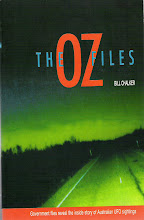
He has contributed to such publications as Rolling Stone and Reader's Digest. Author of the “The OZ Files – The Australian UFO Story” (1996), “Hair of the Alien – DNA and Other Forensic Evidence for Alien Abductions” (2005), Australian chapter author of the UFO History Group’s major study “UFOs and Government” (2012) and Australian content author for all 3 editions of Jerome Clark’s “The UFO Encyclopedia” – the latest in 2 volumes (2018) and in a 7-part series (2021).

Thursday, October 28, 2021

"The US Department of Defense Unidentified Aerial Phenomena Task Force actions or reporting are outside of Defence's remit," Australian Defence states


Updated 2 November 2021 to include Hansard record on the Senate Estimates discussion on UAPs.

Further updated to include the background on why the question came up.

"Remit" in this story context means: "The task or area of activity officially assigned to an individual or organisation". 

Hmm ... one needs deep historical context and more contemporary deep dives of research and investigation in order to attach much significance to these passing statements:

Australia’s ABC News reported today (28 October 2021) reported the following story:

Defence won't follow Pentagon to launch an investigation into UFO sightings or Unexplained Aerial Phenomena 

By defence correspondent Andrew Greene Posted Thu 28 Oct 2021 at 6:13am 

Key points: 

A declassified US report found analysts lacked sufficient data to determine the nature of mysterious flying objects seen by military pilots 

Australia's Foreign Minister, Marise Payne, joked in Senate estimates that it was the first time she had witnessed a parliamentary examination on UFOs 

In June, the Defence Department said it "does not have a protocol" that covers recording or reporting of UFO sightings 

The Royal Australian Air Force chief says Australia has no plans to follow the Pentagon by formally investigating UFOs, insisting his pilots have not reported any recent sightings of unexplained objects in the sky. 

At a Senate estimates hearing, RAAF Chief Air Marshal Mel Hupfeld was quizzed about a declassified US report into the topic released in June by the US Office of the Director of National Intelligence. 

The report, submitted to US Congress, found 

defence and intelligence analysts lacked sufficient data to determine the nature of mysterious flying objects observed by military pilots, including whether they are advanced earthly technologies, atmospherics or of an extra-terrestrial nature. 

Under questioning from Greens senator Peter Whish-Wilson, the RAAF chief confirmed he was not "formally aware" of the report's findings but had noticed it in the media. 

Air Marshal Hupfeld told the committee he had not seen any reports of "unidentified aerial phenomena" — or UAPs — in Australian airspace. 

"I'm not familiar with, nor have seen any reports or information regarding UAPs in an Australian airspace context, and there's no air force-led task force that looks into this phenomenon," he said. 

The RAAF chief was then quizzed on whether Australia's Jindalee Operational Radar Network (JORN) could detect UAPs. 

"It's not possible for me to determine whether the JORN would see something like an unusual airborne phenomenon, without knowing the construction materials and other performance parameters of such an object, if indeed it was an object," he said. 

Photo & Caption from the above quoted ABC story: Air Marshal Mel Hupfeld has been the Chief of Air Force since 2019.(ABC: Cameron Best)

Foreign Minister Marise Payne later joked that it was the first time she had witnessed a parliamentary examination on the topic of UFOs. 

"I can say with some confidence that, after over two decades of participating in the Senate estimates process, this is the first occasion on which, in any capacity, I have had the opportunity to observe a conversation and a question-and- answer session on such an issue. 

"So, thank you for bringing it to our attention," she told Senator Whish-Wilson at the end of the RAAF chief's evidence. 

In June, the Defence Department told the ABC it "does not have a protocol that covers recording or reporting of unidentified aerial phenomena/unidentified flying object sightings". 

"The US Department of Defense Unidentified Aerial Phenomena Task Force actions or reporting are outside of Defence's remit," a spokesperson told the ABC.

Here is a link to ABC’s AM programme on 28 October, 2021, which includes audio of the main comments:

https://www.abc.net.au/radio/programs/am/adf-declines-to-study-ufos/13606984


Here is a video link to the exchange that led to the news item:

https://www.youtube.com/watch?v=OT2fJ2Pw5RU

Thanks to Philippe Ailleris for posting me the link.


Transcripts of the Senate Estimates meeting completed by November 1, 2021. The relevant exchange now on the parliamentary Hansard record is included here:

Senator WHISH-WILSON: I'm not sure exactly who to ask to respond to these questions, because they may well not have been asked before. I was wondering if I could have someone senior from the Air Forceparticularly a pilot, if that's possible.

CHAIR: Who knows how to fly a plane!

Senator Payne: We'll do our best to find you a pilot from the Air Force. I'll call the Chief of Air Force; there's a plan!

Senator WHISH-WILSON: The Chief of Air Force would be great, if that's possible.

Senator Payne: He's a pilot; I've seen him fly.

Air Marshal Hupfeld: I am a pilot. I used to fly aeroplanesnot currently now. I think I've got the information you might need, pending your question.

Senator WHISH-WILSON: I know we have close ties with the US. We share intelligence. My questions relate to the release of the report on 25 June 2021 by the Office of the Director of National Intelligence,Preliminary assessment: unidentified aerial phenomena. This is an issue that has been raised in Congress; the Department of Defense has submitted a report. It's become a significant matter of public interest. I suppose my first question is: are you aware of that report?

Air Marshal Hupfeld: I'm not formally aware of the report. I think there was an article in the newspapers and commentary about that at some stage. But I'm not quite sure of the content of the report.

Senator WHISH-WILSON: Okay. Just as a matter of interest, what questions did you think I was going to ask?

Air Marshal Hupfeld: I thought you were going to ask questions about aircraft, but it sounds like you're going to ask questions about UFOs.

Senator WHISH-WILSON: We'd be very interested to hear your views on this. Yes, it has been reported in the media extensively both here and internationally. I'll just read you a few statements or the executive summary from that report. It basically talks about UAPs as being something that the US Department of Defense is taking seriously, and that the Pentagon has a taskforce assigned to better understand the data interpretation of recent sightings. The report says: 'UAP clearly pose a safety of flight issue and may pose a challenge to U.S. national security.' Then it goes on to talk about the 144 cases that the Pentagon looked at. Only one was clearly explainable; the others remain unexplained. It says that, after carefully considering the information, the taskforce reported that UAPs largely witnessed firsthand by military aviators were 'collected from systems that were considered to be reliable.' It went on: 'Most reports described UAP as objects that interrupted pre-planned training or other military activity.'

Could I ask whether the Australian Air Force or the Australian military also have a taskforce looking at UAPs? Is this something that you're familiar with at all in your brief?

Air Marshal Hupfeld: I'm not familiar with nor have I seen any reports or information regarding UAPs in an Australian airspace context. There's no Air Force led taskforce that looks into this phenomena.

Senator WHISH-WILSON: We don't do any monitoring of this at all?
Air Marshal Hupfeld: There have been no reports that I'm aware of, Senator.
Senator WHISH-WILSON: No informal reports from pilots or across other military activities?

Air Marshal Hupfeld: None from any aircrew or aviation organisation that I'm aware of. The only experience that I have in this was over 40 years ago when some reports were made and we launched Mirage aircraft. The phenomena turned out to be errors on the radar screens in our normal civil air-traffic control system, but no physical objects were detected.

Senator WHISH-WILSON: Does the characterisation of the DOD, in relation to their report, of both intent and advanced technology concern you? Basically, they're saying they can't explain what these things are, but they would like to better understand them.

Air Marshal Hupfeld: I can't answer for another sovereign nation. That is a matter for the US and the Pentagon and the Department of Defense in the US.

Senator WHISH-WILSON: Would it be possible for you to see if, across the other services, there has been any kind of reporting system in relation to this in Australia?

Air Marshal Hupfeld: Certainly, I can take that on notice. But I feel confident that, as the airspace control authority within Australia, if there had been any detections or items such as this, I would have been aware of them. But I can take that on notice to double-check.

Senator WHISH-WILSON: Okay. Typically, would something like Jindalee be able to pick-up fast-moving objects, or is it more designed to look at ships and

Air Marshal Hupfeld: Senator, the Jindalee Operational Radar Network is designed to detect aircraft and some ships. I won't go into the details of the nature of that detection, as we would then be getting into very classified areas. It's not possible for me to determine whether the JORN would see something like an unusual airborne phenomenon without knowing the construction, materials and other performance parameters of such an object, if, indeed, it was an object.

Senator WHISH-WILSON: As a pilot, have you seen any of the video footage that's been released by the US military? It's unclassified and it's been reported on by either the New York Times or the Washington Post. EvenThe Conversation here in Australia, which, as you know, is quite a respectable, conservative media outlet, has written a report. They're not saying they agree that these things may be more than aberrations, but they are saying, 'Finally, there's a mature conversation now happening around UAPs and we're trying to better understand them.'

Air Marshal Hupfeld: Through professional curiosity, I did look at some of the videos that were attached to those media reports. They were interesting but not compelling to me. I don't believe everything that I read in the media.

Senator WHISH-WILSON: No, nor do I. It's certainly something we learn in Canberra. It's just interesting. Do you think it would be possible for pilots to spoof that kind of thing?

Air Marshal Hupfeld: I'm not sure what you mean by 'spoof'. Are you talking about the
Senator WHISH-WILSON: Obviously the video has come from US Air Force pilots. I think there are 80

different sources, and the DOD and Pentagon are taking this seriously.

Air Marshal Hupfeld: I'm not really able to comment on that. There are too many variables to even form a view.

Senator WHISH-WILSON: Thank you for that. If you could just take that on notice, that would be excellent.

Senator Payne: I can say with some confidence that after over two decades of participating in the Senate estimates process this is the first occasion on which in any capacity I have had the opportunity to observe a conversation and a question-and-answer session on such an issue. So thank you so much for bringing it to our attention.

Senator WHISH-WILSON: My pleasure, Senator Payne. I do notice our key ally is taking this very seriously.

Senator Payne: I heard you.

Senator WHISH-WILSON: It is now emerging as a matter of public interest. So I'm glad you appreciate that.

Senator Payne: I listened with great interest. I'm glad we could find you a pilot.

(End of Hansard extract)


For a bit of background perspective, I’ll quote from an interview I did with Robbie Graham back in 2018, which was published on my blog back on September 27, 2018: 

http://theozfiles.blogspot.com/2018/09/ufos-around-world-australia.html

and published in a 2019 special issue of New Dawn.


Robbie asked me:

What is the Australian government’s official stance on UFOs? When was the last time it issued a statement on the subject?


My 2018 response:

While I would argue that Australia’s “official stance on UFOs” (that there was largely nothing to it all) was fully expressed back in 1984, it was restated and expanded upon in 1994 and again in 1996 and even later still. See my chapter in the UFO History Group’s monumental study, “UFOs and Government” (2012). My friend Paul Dean describes the drawn out Australian “swan song” in 2015 and 2016 posts on this theme:

“In the 1994, and further in 1996, the Australian Defence Department increasingly and officially washed their hands of the UFO/UAP matter. This came after some 44 years of official Defence handling of the issue, with the Royal Australian Air Force (RAAF) and the old Department of Air (DOA) begrudgingly doing the lion’s share of the investigative work – if you can call it ‘investigative work’ that is. See, judging by the thousands of declassified and released pages held now at the National Archives of Australia (NAA), its crystal clear that those in RAAF and Aviation officialdom did a sub-standard job of chronological filing, policy development, and last, but definitely not least, actual investigation. Veteran researcher Bill Chalker stated to me in my first phone conversation with him 6 years ago, that his opinion of the government’s handling of the matter, after looking through the files, was ‘an entirely lost opportunity’ for a proper ‘scientific appraisal’ of the UFO matter. He was right then, and he is right now.”

I describe my own take on this:

“Despite cases like the 1973 North West Cape event, the 1983 Melton/Rockbank incident and the 1987 SAS Learmouth report, during December 1993, the RAAF formerly concluded its long love-hate relationship with UFOs, or ‘Unusual Aerial Sightings’ (UAS) as they preferred to call them. The Department of Defence ‘swansong’ was dryly expressed in Enclosure 1 to Air Force file AF 84 3508 Part 1 folio 18 – RAAF POLICY: UNUSUAL AERIAL SIGHTINGS.”

In correspondence dated January 4, 1994, civilian UFO groups around Australia were informed by now Wing Commander Brett Biddington, on behalf of the Chief of Air Staff, that “The number of reports made to the RAAF in the past decade had declined significantly, which may indicate that organisation such as yours are better known and are meeting the community’s requirements.”


The “new” policy, which was an inevitable outgrowth of the downgrading of the RAAF’s role back in 1984, stated:

“For many years the RAAF has been formally responsible for handling Unusual Aerial Sightings (UAS) at the official level. Consideration of the scientific record suggests that, whilst not all UAS have a ready explanation, there is no compelling reason for the RAAF to continue to devote resources to recording, investigating and attempting to explain UAS. 


The RAAF no longer accepts reports on UAS and no longer attempts assignment of cause or allocation of reliability. Members of the community who seek to report a UAS to RAAF personnel will be referred to a civil UFO research organisation in the first instance…


Some UAS may relate to events that could have a defence, security, or public safety implication, such as man-made debris falling from space or a burning aircraft. Where members of the community may have witnessed an event of this type they are encouraged to contact the police or civil aviation authorities.”


Given the rich history of political and military machinations that quite often effectively prevented opportunities for real science, the policy statement alluding to “the scientific record” is particularly perplexing. As a scientist who has examined in detail the RAAF “record” I can state with some certainty that their record was not particularly scientific and was largely defined by two criteria—national security and political expediency. This appeal to “the scientific record” is particularly puzzling as the RAAF regularly highlighted that national security not scientific investigation was their main focus. For example, in a 6 December 1968 memo from DAFI to HQSC in 554/1/30 Part 2, DAFI mentions, “As you are probably aware the Department of Air (later (DOD (Air Office)) is concerned solely with any possible threat to Australian security and does not go into detailed scientific investigation of UFO reports.”


Keith Basterfield reported Melbourne researcher Paul Dean’s recent interview with Brett Biddington who had since retired from the Air Force, who stated, “I wrote the 1994 policy and had a hand in the 1996 policy as well. After the Melbourne sightings I conducted an informal (in the sense I did not document it) literature review of UAS. I also sought help from civilian UFO organisations which claimed knowledge and understanding of the domain. I could find nothing on record that was defensible or sustainable. This is the reference to the “scientific record.”

I had spoken with Brett Biddington back in 2008. He indicated he had left the Air Force as “the most senior Air Force intelligence person in Australia during the 1990s.” He saw himself as still “the RAAF UFO/UAS expert” and regularly got RAAF enquiries. He regarded the “UAS regime” as a response to the Cold War and a way of finding data on “space debri.” He felt he encountered paucity of data in every respect, with “the veracity of the entire system in doubt.” He felt the UAS data had limited historical relevance. The RAAF’s response was always about the doubtful and limited veracity of UAS reports and the grief they caused for the RAAF. He told me that he never saw any case that grabbed his attention, not even the Melton case.

While I would agree that much of the data collected and assessed by the RAAF’s UFO/UAS programme was of limited merit, I also feel strongly that the lack of scientific investigations revealed numerous lost opportunities to do real science. Many impressive cases came to the attention of the RAAF, but rarely were they given the investigation they deserved—both a focus on national security where appropriate, and a scientific investigation. The scientific approach was not part of the RAAF’s investigations in any really significant way, hence the irony of a claim of “a consideration of the scientific record” informing the decision to end the RAAF’s reluctant and erratic embrace with the UFO problem. I wondered why the 1994 and 1996 policies were developed as the RAAF involvement had long since faded to a very low ebb and was always problematic. The UFO problem was always unwieldy and unmanageable for the RAAF. Controversy rather than resolution was a frequent feature. At times it seemed the RAAF were barely doing even a token effort. The RAAF largely resolved any dilemmas they had with intractable or unexplained cases by either burying them with unlikely explanations or simply ignoring the implications of often robust and unexplained events.


I have interviewed highly placed scientists within the Australian intelligence and defence community such as nuclear physicist Harry Turner who headed up the nuclear section of the Directorate of Scientific and Technical Intelligence within the Joint Intelligence Organisation and led a fight for a “UFO science” response within the Australian intelligence and military science community. The chief Defence scientist Dr John Farrands also had a deep interest in the UFO subject. He shared information, his perspectives and told me he had even contemplated writing a book on the subject, but would instead wait for mine. Sadly he passed away about a week after my book The OZ Files—The Australian UFO Story was published, so I never got the opportunity to see what he thought of it.


If the Department of Defence had a sense of an efficient “burial” of “the UFO problem,” someone had forgotten to inform the alleged corpse. The UFO phenomenon has never really passed away, but you would be forgiven for believing it has had many resurrections. Remarkable events continue to occur, providing a challenging testament for the legitimacy of the UFO phenomenon.


Robbie: Does the Australian Ministry of Defence have an official UFO investigations unit?

My reply:

While the Directorate of Air Force Intelligence (DAFI) historically had the central responsibility for investigating UFOs (or UAS—Unusual Aerial Sightings—as they preferred to call them), the drawn out nature of the Australian government’s disengagement from the UFO subject has led to a somewhat fragmented and ad hoc current picture. Paul Dean has elaborated on this, indicating:

“There are currently two Australian government agencies who are equipped to, and indeed do, accept UFO reports from civil aviation flight crews. They are the Australian Transport Safety Bureau (ATSB) and Air services Australia (ASA). Of course, they do more than deal with infrequent UFO reports, and, in fact, are responsible for airspace management, the functionality of airports, pilot licensing, air safety, navigational systems, etc. Australia’s Department of Defence (DoD) also accepts and processes UFO reports, but their system is quite different from those of the ATSB and ASA. The DoD’s Directorate of Defence Aviation and Air Force Safety (DDAAFS) accepts reported military UFO cases via a form called an Air Safety Occurrence Report (ASOR). ASOR’s are processed through the Defence Aviation Hazard Reporting and Tracking System (DAHRTS), and are studied within the Closed Loop Hazard/ASOR Review and Tracking System. DDAAFS military UFO reports have proven very hard to obtain. But ATSB and ASA reports have been somewhat easier.”


Robbie: Has the Australian government shown more or less transparency on the UFO subject than the US and British governments?

My reply: 

The Australian government’s approach was more of a middle ground, but defined in a somewhat ad hoc way by the principle of “the ties that bind,” namely Australia’s relationship with its major defence partners—the US and the UK. While Australia routinely followed the lead from the much larger scale UFO investigations of the US Air Force, the government also took stock of the approach of the UK, which only in more recent years had become more open with their UFO files.


My own direct access of the Australian government UFO files was generally pretty open. During 1982 to 1984 I was able to examine a continuity of DAFI UFO files from 1955 to 1982, and since then filled in many of the gaps before and after those years. Through those investigations I was able to make contact with a lot of official players, particularly Defence scientist Harry Turner. Keith Basterfield, through an Australian disclosure programme, extensively supplemented and complemented my earlier investigations of official government files.


There is way more to discuss on this brief exchange at the Senate Estimates meeting. History will express the fallout of the comments.  


Back on October 31st I highlighted a link on my Facebook page to the Tasmanian Greens Senator's interview with Brian Carlton on Triple M Hobart 107.3 radio on 28 October in which Senator Peter Whish-Wilson gave an explanation as to why he asked the UAP question in Senate Estimates, paraphrasing:

"Over 20 years ago (presumably prior to 2000? - B.C.) a friend of mine, who I grew up with, he went into the Special Forces.  He went to Iraq & he went to East Timor.  He told me over 20 years ago, he was on a exercise.  He didn't tell me exactly where it was of course, on a boat.  Early in the morning they were basically followed by a metallic Tic Tac - an object.  He told me about this years ago - he and his mates didn't do anything about it because they were embarrassed. I was back in Western Australia in July, a month after the Pentagon report release and I caught up with him for a beer.  He said, you remember when I told you about this.  I said yes I do, it was out of character for you, because he was a no nonsense kind of fellow.  He said, Well, its out there now, people are talking about it it.  There are a lot of people in the services who have seen similar things."


Lets hope the new push to more openness might persuade this man and his many service colleagues to come forward with details of their experiences.  Many have come out over the decades, but it is an indictment on the toxic culture of ridicule and silence, that people have been constrained to reveal their experiences.